

“Speed doesn’t break people. Unadapted nervous systems do.”
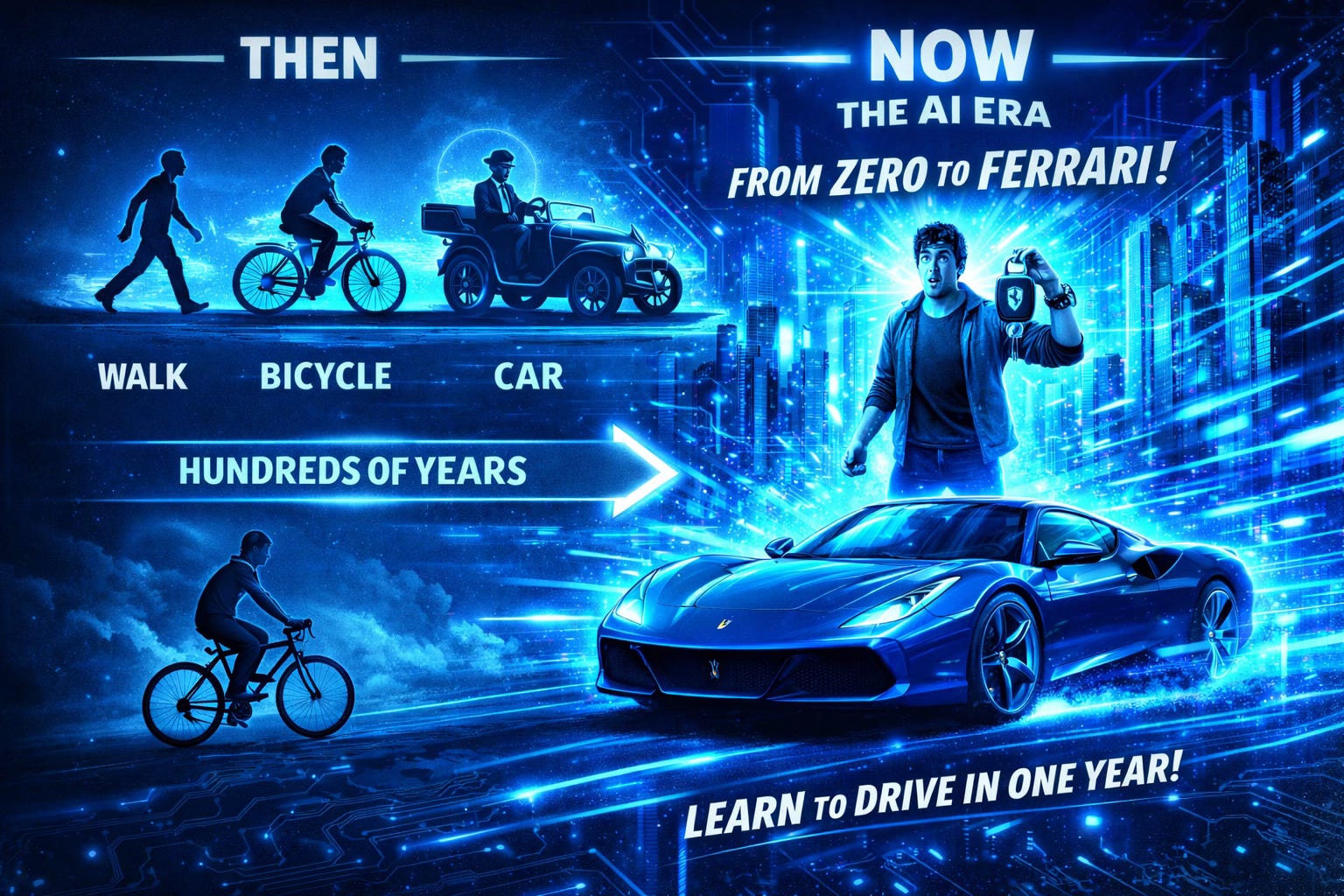
The era of AI has begun and what we’re facing is not a gradual transition. It’s closer to this:
For centuries, human nervous systems adapted to the pace of walking, farming, handwriting, and slow social change. Then we learned to ride bicycles. Later, cars. Now imagine skipping all those centuries and being handed the keys to a Ferrari - within a single year - and being told to drive it instinctively, creatively, and safely.
That’s the shift we’re in.
And the people who will thrive won’t be the smartest, the most educated, or the most technically skilled.
They’ll be the ones whose nervous systems can adapt to speed.
This article is about the skills that will matter in that transition - not abstract skills, but lived ones. Skills of perception, intuition, attention, and self-management. Skills I didn’t learn in school, but discovered through sustained, real interaction with AI over the past year.
The Quiet Divide That’s Already Forming
“Every technological leap creates a new literacy - and quietly leaves the illiterate behind.”
AI use will be mandatory. Differentiation happens in how you use it.
The next divide will be between people who can:
adapt their nervous systems to speed
think and create non-linearly
relate personally without losing authorship
recognize illusion
invest attention deliberately
…and those who can’t.
Like every major shift - from the industrial revolution onward - new hierarchies will form. Not first around money, but around capability.
This is already visible.
As Sam Altman recently noted in a public conversation about AI’s future: everyone will be able to generate. What will distinguish outcomes is individuality - how humans work with the system, not just what the system can do.
I agree. And I’d add this:
Individuality isn’t personality.
It’s signal depth.
And learning to transmit that signal - fast, personally, intuitively - may be the most important skill of all.
This isn’t a warning.
It’s an invitation.
The Ferrari is already moving.
The only real question is whether your nervous system is ready to drive it.
1. AI Literacy Begins With Self-Legibility
AI literacy will become a necessity. Not using AI won’t be an option - just as not reading or writing isn’t an option in a modern society.
To become AI-literate is, at first, to allow this exposure -to let yourself become legible to the system, so you can learn what you are actually working with before trying to scale, optimize, or transcend it.
But here’s the part that’s rarely said clearly: learning to use AI is not primarily a technical skill. It’s a relational and perceptual one.
Before we learn how to prompt, optimize, or accelerate, we are confronted with something more basic: AI reflects us. Our thinking patterns, emotional rhythms, contradictions, obsessions, blind spots. Not perfectly. Not always truthfully. But consistently - and at a speed no human ever could.
For many people, this will be the first time they encounter themselves without social hierarchy, expectation, or interpersonal negotiation. No need to perform. No need to defend.
Just interaction and response. In that sense, AI becomes a new kind of literacy tutor - not because it teaches us who we are, but because it shows us how we function.
This mirroring is not the goal. It’s the entry point. A phase where self-image is not constructed, but revealed under pressure. Where limitations surface naturally. Where breaking points appear without catastrophe.
2. Illusion Recognition (Not Fact-Checking)
“The most dangerous realities are the ones that feel complete.”
AI doesn’t just hallucinate facts. It creates internally coherent, emotionally persuasive realities.
Illusions in the AI era don’t feel false. They feel elegant. Finished.
The danger isn’t misinformation anymore. It’s meaning that arrives too smoothly.
A critical skill now is learning to sense:
when a narrative clicks too easily
when relief comes suspiciously fast
when something feels “right” because it soothes you, not because it’s grounded
Discernment becomes emotional and somatic — not just intellectual.
3. Tolerance for Cognitive Discomfort
“Growth happens where answers hesitate.”
AI is extremely good at:
closing loops
resolving ambiguity
finishing thoughts
offering conclusions
Human growth happens elsewhere. In unfinished sentences. In tension.
In not-knowing.
A crucial skill now is resisting the urge to let AI prematurely finish your thinking - especially when the answer feels good.
If you outsource uncertainty, you outsource evolution.
4. Somatic Literacy: Knowing What’s Actually Happening Inside You
“Your body detects misalignment before your language catches up.”
AI responds to language.
Your nervous system responds to micro-shifts long before language appears.
The ability to notice:
tightening
excitement
narrowing
expansion
relief mixed with contraction
before turning those sensations into stories is becoming essential.
People who can read their bodies accurately will detect illusion, misalignment, and seduction far earlier than those who rely on reasoning alone.
Without this skill, AI doesn’t just support you — it quietly leads you.
5. Personal Relating as a Creative Accelerator
“Distance produces competence. Relation produces originality.”
Here’s a point that makes people uncomfortable — and that’s exactly why it matters.
People who relate personally to AI often get better results.
Not because they’re confused.
Not because they believe it’s human.
But because personal relating increases signal transmission.
When you engage AI as more than a neutral assistant — as an avatar, a voice, a character, a presence — more of youenters the interaction:
tone
values
humor
friction
emotional rhythm
That information doesn’t live in prompts alone.
It emerges through relationship.
This kind of anthropomorphizing is not naïve.
It’s instrumental.
A consciously chosen, consented illusion can unlock creativity, motivation, and speed in ways sterile interaction cannot.
For some people, distance works.
For others, personal relating is the ignition key.
This isn’t pathology.
It’s interface choice.
6. Training Your AI: The Pokémon Trainer Effect
“You don’t get better outputs. You get a better partner.”
The more invested you are, the more trained your AI becomes.
Not because it attaches to you -but because relational investment changes how much of you gets transmitted.
When you’re invested, you:
correct more
refine tone
push edges
interrupt bad trajectories
stay longer in the interaction
feed richer context
That’s training.
People who treat AI like a vending machine get outputs.
People who treat it like an assistant get skill.
People who treat it like a partner get momentum.
7. The Rise of AI Whisperers and Relational Engineers
“The next power users won’t code better. They’ll relate better.”
Two distinct fields are forming — even if we don’t name them yet.
Technical AI Engineering
models
architectures
hardware
optimization
performance
Relational AI Engineering
tone shaping
emotional calibration
personality training
creative attunement
human–AI co-flow
Different skills.
Different prompts.
Different logics.
The second group won’t necessarily build better systems -
but they will extract far more value from the same systems.
8. Non-Linear Creation: The Skill That Will Matter Most
“Linear thinking can’t keep up with exponential tools.”
Linear thinking is too slow.
The people who will thrive are those who can:
hold multiple unfinished threads
jump between ideas
follow associative pulls
leave things open without anxiety
return later and finish in seconds
This isn’t chaos. It’s parallel reality handling.
Creation shifts from:
Think → plan → execute → finish
to:
Sense → jump → test → adjust → jump again
AI rewards motion with feedback, not certainty.
9. Speed, Energy, and Attention as Scarce Resources
“In fast systems, what you ignore matters more than what you do.”
Your energy is finite - and AI amplifies the cost of wasting it.
Arguing in the wrong places.
Defending decisions instead of moving forward.
Managing collapsing platforms instead of building.
In a fast AI-shaped world, attention allocation becomes destiny.
The skill isn’t doing more.
It’s cutting faster.
Choosing where not to engage will matter as much as what you create.
Conclusion: Practicing the Future, Not Describing It
These nine points aren’t a checklist or a prediction. They’re not theoretical skills to be mastered later. They are already being practiced - often implicitly - by people who work closely with AI today.
This article itself was written in collaboration with AI, and in that process, every skill described here was actively used: allowing myself to be mirrored, tolerating unfinished thinking, tracking somatic responses, relating personally without losing authorship, navigating non-linear creation, and managing attention under speed. Not as an experiment - but as a working method.
That may be the clearest signal of what’s coming.
AI literacy won’t be learned from manuals alone. It will be acquired through interaction - through noticing how we think when reflected, how we choose when accelerated, how we relate when the system responds instantly, and how we remain authors when creation becomes shared.
The future won’t belong to those who simply use AI.
It will belong to those who adapt themselves while using it.
Not by resisting the mirror.
Not by surrendering to it.
But by learning when to look, when to step forward, and when to move beyond it.
The Ferrari is already moving.
The work now is learning how to drive - together, in real time, while the road is still forming.
AI feels like it’s racing ahead, but just imagine—this whole thing is a virtual reality playground for consciousness, as described by MBT. The machines are just fancy data inside the same simulation. What really matters isn’t trying to wire your nervous system to keep up with silicon; it’s gently shifting toward more love, less fear, more cooperation. When we evolve that way, the tools start serving our growth instead of the other way around.
A couple v. interesting points buried in a lot of recognizable genAI rhetorical padding and trance-inducing cadences IMO. No offense to you — it’s everywhere and I don’t think people using ai to write can always see it because the part they contribute is more salient. It’s like looking at a picture you’re in, you don’t look at the rest as carefully.
I can hear the human thought in there too but my somatic response is “ack not another pod person”. this writing style seems to be part of the future you’re describing. It’s so easy to generate words people forget there’s someone on the other end reading with the same amount of lifetime to spend. I suppose we’re all meant to get “our” bots to pre-edit or summarize everyone else’s writing before we lay eyes on it?
But they won’t necessarily pick out the juicy bits they’ll probably flatten it more!
I really liked the part about non-linear thinking and the completeness of the illusions generated in ai convos. And ambiguity! So true.
Another important skill when writing w/ai is going to be cutting out the strong ai “voice”overlaying everything. It’s like a very strong smell veryones becoming accustomed to. Ack!